
This year’s local Christmas Bird Count (CBC) took place on January 3, with 14 volunteers who counted from their cars, on foot, and at their backyard feeders. Altogether, they observed 45 species and 2,650 individual birds (plus a Black Vulture during Count Week).
During our December 2024 CBC, we saw 44 species and 5,440 individual birds, so this year’s number of species was nearly identical, but the number of individual birds was much lower.
This change was thanks in large part to the number of European Starlings—only 291, compared to 2,960 last year. Also, many bodies of water were frozen over, with Prairie Creek being almost completely iced in, probably leading to a big drop in Ring-billed Gulls (from 500 in 2024 to just 1 this year).
Other changes were less dramatic, with the number of many woodland species going down (e.g., Carolina Chickadee, White-Breasted Nuthatch, Carolina Wren) and sparrows going up (American Tree, White-crowned, White-throated, and Song).
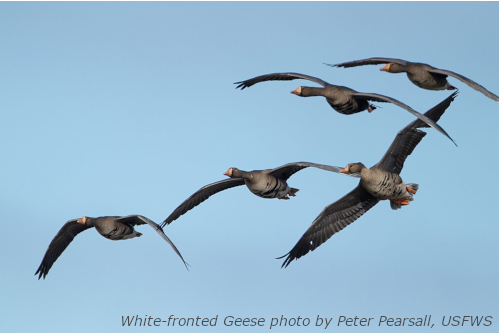
Notable species not on last year’s report were 75 Greater White-fronted Geese (flying over Prairie Creek), one Trumpeter Swan, and 255 Horned Larks.
An unusual sighting for this time of the year was the Black Vulture, and two participants spotted a Peregrine Falcon southwest of Muncie. Full results are available here.
Big thanks go to the volunteers who participated in the count, especially Jim Schowe, who coordinated counters and count areas, and Catherine Kubo, who coordinated counters’ eBird lists and processed the results. Other counters were Julie Bruner, Jim Flowers, Barb Hesselgrave, Martha Hunt, Jim Jeffery, Rose Jeffery, Janet Ridenour, Erv Rockhill, Lois Rockhill, Annette Rose, Barb Stedman, and Kristy Tuttle. Altogether, the 14 counters covered a 10-miles radius from the center of Muncie over the course of several hours. They drove more than 91 miles, walked 4.69 miles, and spent well over 5 hours watching at feeders.
The National Audubon Society conducted the first Christmas Bird Count in 1900, making it the Western Hemisphere’s longest-running wildlife census and one of the world’s greatest ongoing citizen-science efforts. Scientists use the data gathered to help track trends in bird populations and address conservation issues.
National CBC results for this year’s count won’t be available for several weeks, but in the meantime, you can review last year’s count results—for the 125th year—at www.audubon.org/news/125th-christmas-bird-count-summary.
(Photo of Greater White-fronted Geese by Peter Pearsall, USFWS)
 Robert Cooper Audubon Society