Jan. 21 | 7 p.m. | BSU Nature Lab & Zoom
The study of movement ecology is undergoing a renaissance driven by new technologies, such as automated radio telemetry through the Motus Wildlife Tracking Network. Motus enables monitoring of tagged individuals across a network of receiver towers, eliminating the need for hand-held tracking while providing insights into animal movement throughout their entire annual cycle. This has greatly advanced our understanding of migratory bird ecology across species’ ranges.
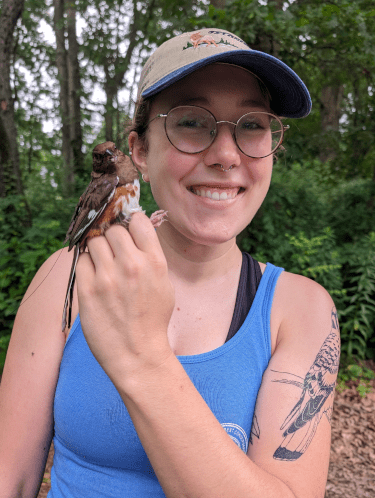
For our January program, Kaitlyn Young, a Ph.D. student at Louisiana State University, will share findings of her master’s thesis research, for which she used Motus technology to investigate the movement ecology of two migratory species: the Eastern Towhee and Northern Saw-whet Owl. She’ll discuss the major findings of her research, which demonstrate how Motus technology allows researchers to learn more about the entire annual cycle of individual species, at a time when anthropogenic pressures threaten migratory bird populations.
In addition to being an early career ornithologist, Kaitlyn was a 2024 recipient of the Josie & Geoff Fox Graduate Student Grant, awarded by our chapter.
Kaitlyn will be giving her presentation remotely, via Zoom, but we hope you’ll join us in person, at the Ball State’s Nature Lab, located at 2500 W. University Ave. in Muncie, to watch her presentation on a large screen. Parking is available on the south side of the building and is free after 5 p.m. The building is wheelchair-accessible.
Or, to watch her presentation by Zoom, please register in advance, below. After registering, you’ll receive confirmation and details about joining the meeting.
(Photo of Kaitlyn with Eastern Towhee provided)
 Robert Cooper Audubon Society